Two Fixes to Stop Sideline Yelling: Parent Sideline Behavior Scripts
Good parent sideline behavior means cheering effort, staying quiet on tactics, and taking any real concern to a coach in private, not shouting it across the field. Do two things starting this weekend: pause three full seconds before you yell anything, and swap instructions for one of two phrases, “Nice hustle” or “Way to keep going.” Referees are leaving youth sports over exactly this, and kids remember the yelling long after they forget the score.
TL;DR:
- Most parents need to pause three seconds before yelling and replace tactics with phrases like “Nice hustle” to promote supportive sideline behavior.
- Negative sideline actions are linked to declining referee participation and increased antisocial behavior among youth athletes, impacting overall game quality.
- A simple, clear code of conduct and consistent enforcement, starting with a preseason meeting, can significantly reduce inappropriate parent behavior.
- Escalating incidents of aggression must be documented immediately and handled with a strict escalation ladder, including removal and reporting within 24 hours.
- Effective communication tools and pregame rules help prevent confusion and frustration that often lead to hostility and damaging sideline conflicts.
Table of Contents
- What Parent Sideline Behavior Actually Looks Like
- What the Research Says About Sideline Behavior
- Building a Code of Conduct That Actually Gets Enforced
- Scripts and a Printable Checklist for the Sideline
- When a Parent Turns Aggressive: What to Do Right Now
- How Clear Communication Cuts Down Sideline Conflict
- Spotting a One-Off Outburst vs. a Pattern Worth Escalating
- Legal and Liability Risk When Sideline Conduct Turns Aggressive
- Real Consequences: What Happens When Sideline Behavior Goes Unchecked
- Where to Learn More About Positive Sideline Behavior
- A Coach’s Honest Take on Fixing This
- Try Athlo to Keep Your Team’s Communication Off the Sideline
- Sources
- FAQ
What Parent Sideline Behavior Actually Looks Like
Sideline behavior falls into three rough buckets, and most parents drift between them without noticing. Supportive behavior is easy to spot once you know what it isn’t: it’s clapping for a good hustle play regardless of the score, cheering both teams after a hard-fought point, and staying silent when the ref makes a call you disagree with. Distracting behavior is subtler and often comes from good intentions, like shouting “pass it!” or “get back on defense!” every thirty seconds. It overrides the coach and confuses the kid, who now has two conflicting voices in their head mid-play. Hostile behavior is the one everyone recognizes: yelling at officials, mocking the other team’s players, or confronting another parent.
Run this quick self-check before your next game:
- Am I narrating the game instead of watching it?
- Have I said a player’s or ref’s name in a frustrated tone in the last ten minutes?
- Would I be comfortable if my kid heard exactly what I just said?
- Am I cheering the effort or just the outcome?
- Could a stranger tell which team I’m rooting for from my tone, not just my words?
If two or more answers make you wince, that’s the signal to dial it back before, not after, the next whistle.
What the Research Says About Sideline Behavior
The referee shortage isn’t a mystery. A NASO/NFHS survey found more than two-thirds of officials reported declining fan sportsmanship, and that decline is a direct driver of officials quitting the whistle for good. Fewer refs means more forfeited games and rescheduled seasons for everyone.
Negative sideline actions from parents predicted measurable increases in antisocial behavior among the athletes themselves, not just discomfort in the moment.
That finding comes from a 2024 Frontiers in Sports and Active Living study, which tracked how parental conduct on the sideline showed up later in kids’ on-field choices. Baylor College of Medicine researchers add the mental-health piece: aggressive or overly critical parenting from the sideline causes real shame and embarrassment in children, and they recommend routing any concern through a private conversation instead of a public outburst. Shame doesn’t build a growth mindset. It builds kids who want to quit.
Building a Code of Conduct That Actually Gets Enforced
A code of conduct only works if it’s short enough to remember and clear enough to enforce without a debate. Six to eight lines, posted where parents will actually see them, beats a two-page PDF nobody reads:
- Avoid coaching from the sideline. Trust and support the coach’s role.
- Cheer for effort, hustle, and participation rather than only focusing on goals or wins.
- Never address an official directly. Route concerns through the team liaison.
- No criticism of any child, on either team, ever.
- Disagreements about playing time go to a scheduled call, not a postgame confrontation.
- Keep phones and cameras out of the playing field to avoid distractions; this is why every team parent needs a youth sports camera to capture moments without causing sideline tension.
- Follow a clear enforcement approach beginning with a warning and escalating appropriately to removal if necessary.
Introduce this at a preseason meeting, not a group text three weeks in. Post it on the fence at every home game and pin it in the team chat so nobody can claim they missed it. When someone crosses the line, follow the same ladder every time: a calm verbal warning, a documented formal warning if it happens again, removal from that game’s sideline, and a suspension from future games for repeat offenders.
Pro Tip: Enforce the ladder the same way for the loudest parent and the quietest one. Selective enforcement is what turns a reasonable rule into a grudge match.
Scripts and a Printable Checklist for the Sideline
Words matter more than volume. Swap “get back on D!” for something that supports the coach’s job instead of competing with it. A few swaps to memorize:
- Instead of correcting a mistake, say “Shake it off, next play.”
- Instead of yelling a tactic, say “Great hustle” or “Nice try.”
- Instead of arguing a call, say nothing and clap for the next play.
- Instead of a public complaint about playing time, say “Can we set up a call this week?”
- Instead of criticizing another kid, say nothing at all. It’s not your kid.
For coaches handling a parent who’s crossed the line mid-game, keep it low and private: walk over between plays, say “Let’s talk after the game, I need you to hold off for now,” and follow up in person, not in front of other families. Public callouts almost always escalate rather than resolve.
| Checklist item | Why it matters |
|---|---|
| Praise effort, not just results | Builds resilience over outcome anxiety |
| Stay silent on tactics | Prevents mixed signals with the coach |
| Route concerns to the liaison | Keeps disputes off the sideline |
| No comments on other kids | Protects every child, not just yours |
| Clap for both teams’ good plays | Models sportsmanship in real time |
| Allow some time to cool down before initiating any formal complaint or discussion. | Cools reactive, in-the-moment anger |
| Know the enforcement ladder | Removes surprise if you’re pulled aside |
Pin that table to your phone or drop it in the team group chat before opening day. The Positive Coaching Alliance calls this “no directions cheering,” and it’s one of the simplest habits a parent can adopt because it requires giving up almost nothing except the urge to backseat coach.
When a Parent Turns Aggressive: What to Do Right Now
Escalation on the sideline moves fast, and hesitation makes it worse. If a parent becomes confrontational or physical, follow this sequence without pausing to debate it in the moment:
- Get players away from the confrontation immediately. Their safety comes first, full stop.
- Have the designated sideline liaison or team manager step in to separate the parties.
- Call venue security or 911 if there’s any threat of physical contact. Don’t wait to see if it cools down on its own.
- Document everything afterward: names, time, what was said, and any witnesses, while it’s still fresh.
- Report the incident to the league or club administrator within 24 hours using their formal process.
Pro Tip: Write your documentation before you go home, not the next morning. Memory of exact words fades fast, and vague notes are useless if the league needs to take action.
Afterward, check in briefly with any kids who witnessed it. A short, calm “that wasn’t okay, and it wasn’t about you” goes further than pretending nothing happened. If a child seems shaken beyond the game, that’s the point to loop in a school counselor or mental-health resource, not to brush it off as part of youth sports.
How Clear Communication Cuts Down Sideline Conflict
A surprising amount of sideline tension starts with confusion, not malice. A parent who doesn’t know the actual start time, doesn’t know the coach’s substitution policy, or hears about a schedule change secondhand shows up already frustrated. Centralized team messaging and a shared schedule remove that friction before it ever reaches the fence line.
Apps built for youth sports logistics, like Athlo, give parents a single parental view of schedules, secure team messaging, and event ticketing, with QR entry, so nobody’s guessing who’s allowed on the sideline or when the game actually starts. That’s not a fix for a parent determined to yell at a ref. It is a real fix for the much more common problem: confusion that turns into blame. Clear pregame messaging and one shared source of truth solve half the arguments before the first whistle.
Spotting a One-Off Outburst vs. a Pattern Worth Escalating
Every parent has a bad moment. A single sharp comment after a controversial call, followed by a genuine apology and no repeat, is a one-off. It deserves a quiet word, not a formal file. What separates a bad moment from a real problem is repetition and lack of self-correction.
Track it against three questions. Did it happen again within the same season? Did the parent acknowledge it, or deny it happened at all? Did it involve a specific target, meaning a particular child, coach, or official, rather than general frustration at the scoreboard? A pattern shows up when the answer to two or more of those is yes.
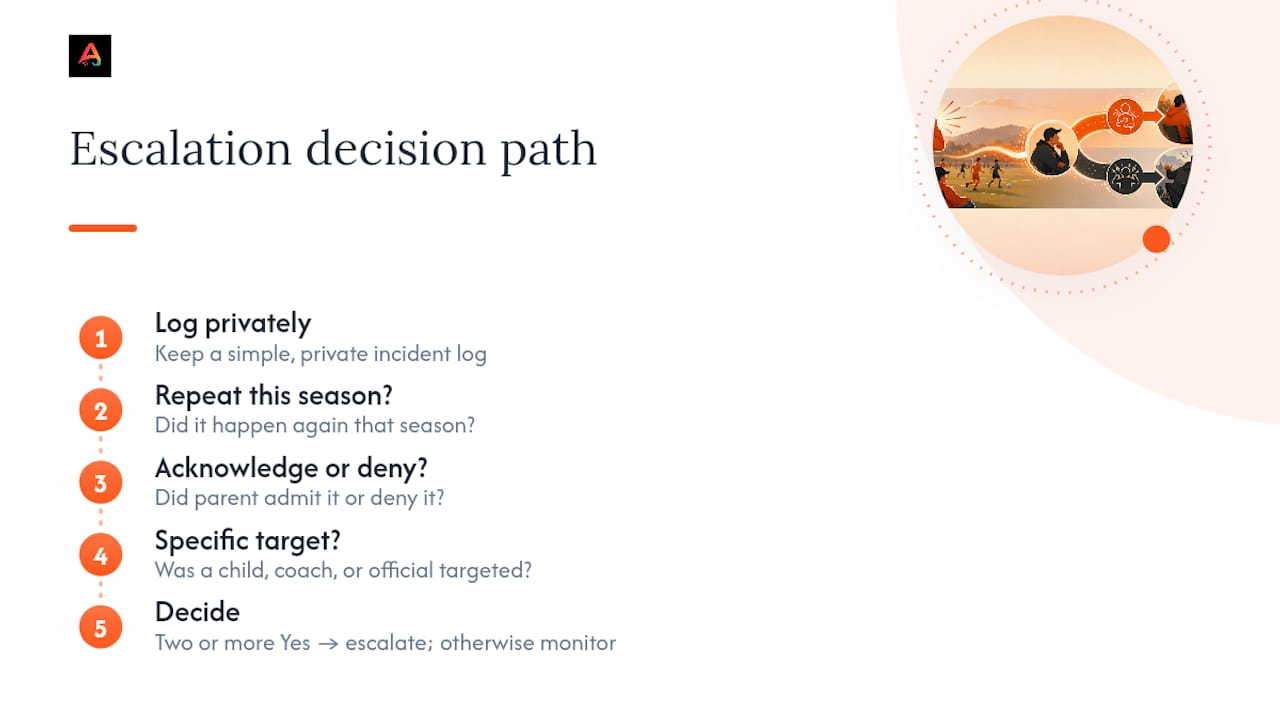
Coaches and league administrators should keep a simple, private log, not to build a case against anyone, but to tell the difference between a rough Saturday and a recurring issue. One incident report after a tough loss doesn’t need the enforcement ladder’s higher rungs. Three incidents across a season, especially ones aimed at the same referee or the same kid, absolutely does.
The mistake most clubs make is treating every complaint as equally serious, which either overreacts to a one-time slip or underreacts to a slow-building pattern. A parent who snapped once during a rain-delayed double-header and never did it again is a different situation than a parent who’s been quietly warned twice and shows up louder each time. Match the response to the pattern, not just the moment, and document both so the next incident, if there is one, has context instead of starting from zero.
Legal and Liability Risk When Sideline Conduct Turns Aggressive
Aggressive sideline conduct isn’t just a sportsmanship problem. It can carry real legal exposure for the parent involved and for the club or league that fails to act. Physical altercations at youth games have led to assault charges in numerous documented incidents across the country, and a parent who threatens or touches an official, coach, or another parent can face criminal liability separate from anything the league decides internally.
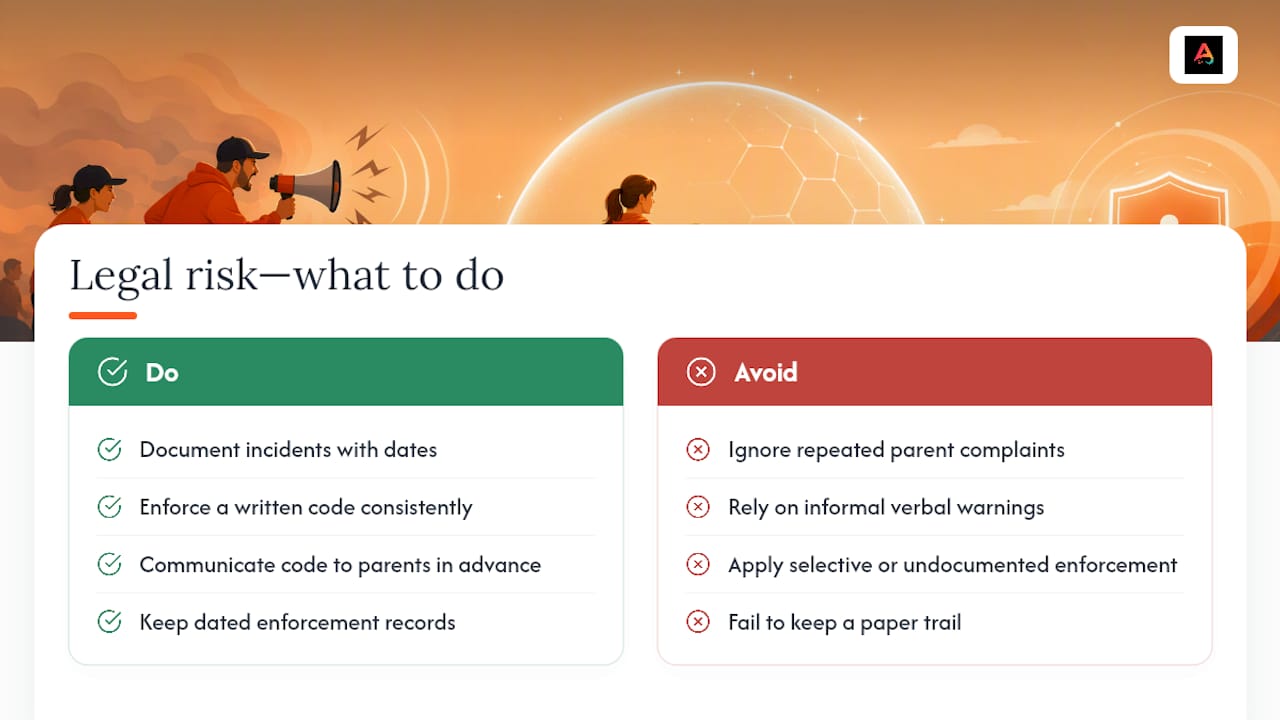
Clubs carry their own exposure too. A league that receives repeated complaints about one parent and takes no documented action can face liability if that parent later injures someone, particularly if the organization’s own code of conduct exists on paper but was never enforced. This is exactly why the documentation step after any incident matters beyond record keeping. It’s the paper trail that shows the organization acted reasonably if a situation ever escalates to a legal claim.
Insurance carriers for youth sports organizations increasingly ask about code-of-conduct policies and enforcement history when underwriting liability coverage. A club with a written policy, a consistent enforcement ladder, and dated incident records is in a stronger position than one relying on informal, verbal warnings that nobody wrote down. Parents should know that a suspension from a league, unlike a criminal charge, is a private club decision the organization is generally within its rights to make, provided the code of conduct was communicated in advance and applied consistently. Selective or undocumented enforcement is where clubs get themselves into legal trouble, not the suspension itself.
Real Consequences: What Happens When Sideline Behavior Goes Unchecked
The pattern shows up the same way across leagues nationwide: a parent’s behavior escalates because nobody addressed the first incident, and by the time anyone does something, the damage extends beyond one bad afternoon. Referees who report declining sportsmanship don’t just complain, they leave, and the NASO/NFHS survey ties that departure directly to games getting canceled or rescheduled for lack of available officials. A single ugly incident can ripple into an entire weekend of youth games getting shuffled because the officiating pool shrank by one more person who decided it wasn’t worth it.
On the athlete side, the consequence is quieter but longer lasting. Kids whose parents were the loudest, harshest voices on the sideline report more shame and more pressure around a game that’s supposed to be fun, according to Baylor’s research on parental sideline behavior. Some of those kids simply stop signing up the following season. Nobody labels that a “consequence” on a scoreboard, but a league that quietly loses ten percent of its registrations to burnout and shame has a real problem that started with sideline noise nobody addressed early enough.
Leagues that adopted a short preseason “sideline reset” meeting, where coaches, parents, and team captains agree on five to seven ground rules together, report dramatically fewer in-game infractions than leagues that skip the conversation entirely, according to practitioner reporting on parent involvement. The fix is almost embarrassingly simple compared to the cost of skipping it.
Where to Learn More About Positive Sideline Behavior
Nobody expects a parent to intuit good sideline conduct from nothing, and pretending otherwise is part of why this problem persists. The Positive Coaching Alliance publishes free, practical self-regulation guides built specifically for the parent standing at the fence, not for coaches or administrators, which makes it one of the more usable resources available. Their “no directions cheering” framework is worth reading in full before the season starts, not after a bad game.
The PMC review of spectator behavior interventions is denser but valuable for coaches and league administrators specifically, since it documents that brief educational sessions measurably shift parents’ stated intent to yell or coach from the sideline. That’s a meaningful data point for any club deciding whether a preseason meeting is worth the extra thirty minutes. It usually is.
For hands-on scripts and firsthand accounts of what actually gets said at youth games, The Sideline Project’s practitioner writing reads less like an academic paper and more like a coach talking directly to a parent, which makes it easier to actually absorb and use. Clubs looking to build their own training should pair one research-backed source with one practitioner voice like this, rather than relying on either alone. A short handout referencing both at the preseason meeting covers the theory and the practical language in the same conversation.
A Coach’s Honest Take on Fixing This
Most sideline blowups aren’t villain moments. They’re regular parents who love their kid too much to sit still, and that’s forgivable right up until it isn’t managed. If your team does nothing else this season, do three things: agree on a written code of conduct before the first practice, teach the two or three praise-only phrases everyone can lean on, and run a short preseason reset meeting where parents help write the rules instead of just receiving them. Rules people help build are rules people actually follow.
— Abdulazeez
Try Athlo to Keep Your Team’s Communication Off the Sideline
Athlo is the alternative to the group text and the paper flyer for keeping youth sports parents informed. Instead of chasing down game times through three different channels, families get one shared view: schedules, secure team messaging, and event ticketing, with QR entry, all in one place.

Half the sideline tension this article covers starts with confusion, not malice. A parent who’s not sure when the game starts or who’s allowed on the field shows up already on edge. Athlo’s parental view puts schedules and updates in one spot so nobody’s guessing, and its coaching marketplace gives frustrated sideline energy somewhere constructive to go if a parent actually wants to get involved in coaching. If your club runs pickup games alongside league play, LinkUp handles discovery and attendance without another spreadsheet. Download Athlo free on the App Store or Google Play and get your team’s communication off the group chat and into one place built for it.
Sources
- Parental spectator behavior and youth athlete outcomes (Frontiers, 2024)
- Unruly sports parents’ effect on children’s mental health (Baylor College of Medicine)
- Spectator behavior and educational interventions (PMC review, 2021)
FAQ
What is the 7-7-7 rule for parents?
The 7-7-7 rule refers to a guideline some parenting educators use around screen time and structured activity blocks, but it isn’t a standard specific to youth sports sideline conduct. No research cited in this article ties a “7-7-7” framework to sports parenting specifically.
My 7-year-old is acting out of control at games. What can I help do?
Start by checking your own sideline behavior first, since the Frontiers study found parental conduct predicts measurable increases in antisocial behavior among athletes themselves. Praise effort quietly, remove pressure around outcomes, and talk to the coach privately if the acting out continues past one or two games.
How should I deal with a rude or confrontational parent on the sideline?
Address it calmly and privately, not in front of other families, and follow a written enforcement ladder starting with a verbal warning. If the parent becomes aggressive, remove players from the area first and involve a designated liaison or security immediately.
How can I tell if I’m being too hard on my young athlete?
If your comments focus more on mistakes than effort, or your child seems anxious before games rather than excited, that’s a signal worth adjusting. Baylor’s research on parental pressure links critical sideline behavior directly to shame and reduced enjoyment in young athletes.