Sports AI Scouting: What It Sees, What It Misses
AI scouting means software watches video, drill results or stats and flags players a human scout might never have seen. It is good at volume and geography. It is not good at character. If you are a player, parent or coach, the smart move is to treat an AI report as a starting point: useful for getting noticed, never the final word on a kid.
Here is how it works, how accurate it is, and what to check before a young athlete’s footage goes anywhere.
TL;DR
- AI scouting turns video, drills, stats and movement data into comparable profiles, so players outside the big academies can get looked at.
- In one NBA study a model beat traditional scouting at predicting future elite players, but the authors still concluded that human judgment can’t be replaced.
- Reviews of youth studies flag bias, small samples and models that fall apart outside the club they were built on.
- Before a minor’s footage is uploaded, ask who sees it, how long it is kept and whether a parent consent is on file.
- Use AI to get seen and to measure progress. Let coaches and scouts judge attitude, effort and growth.
Table of Contents
- What AI sports scouting actually does
- What the data looks like
- How athletes get assessed
- How accurate is it compared with human scouts?
- Bias, privacy and the kid behind the data
- How coaches and parents should use an AI report
- Getting noticed without waiting for a scout
- Where Athlo fits
- Our perspective
- FAQ
- Sources
What AI sports scouting actually does
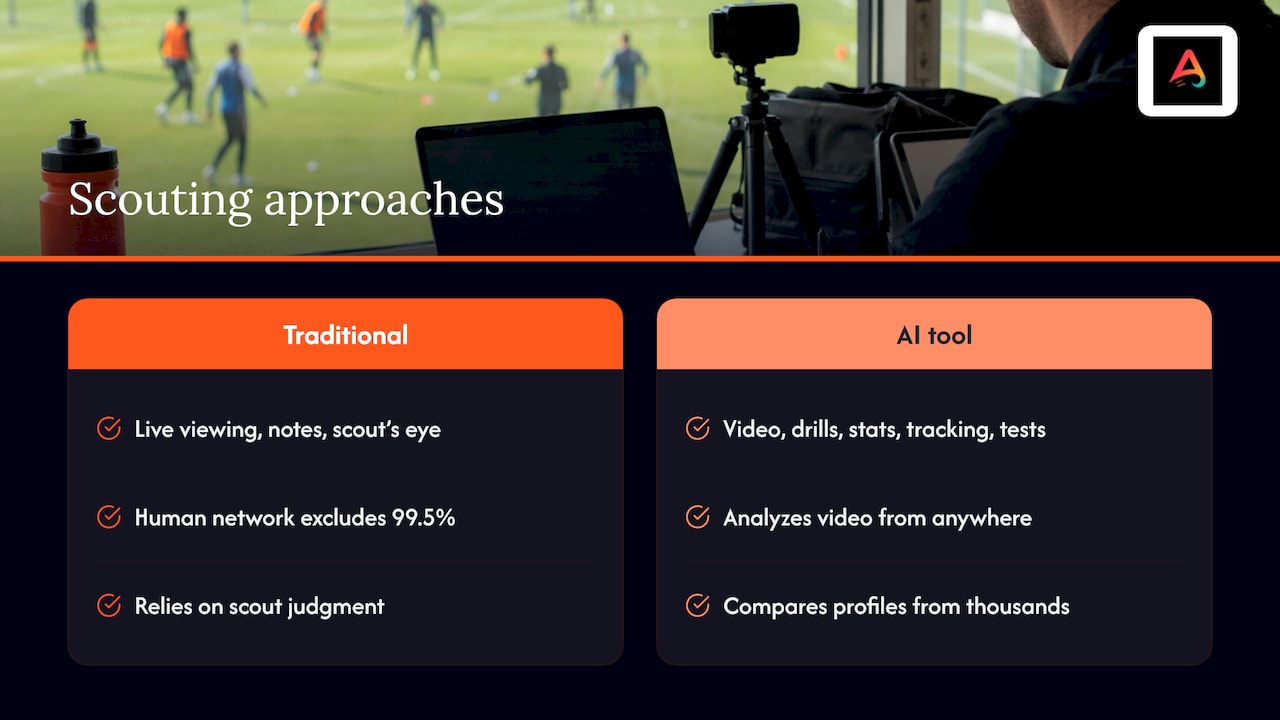
A traditional scout watches a player live, takes notes and trusts their eye. An AI scouting tool takes inputs a computer can read: game video, standardized drills filmed on a phone, box-score stats, tracking data and athletic testing. It then compares a player against profiles built from thousands of others.
The pitch is reach. U.S. Soccer’s chief operating officer said at a 2026 summit that 50 to 70 million American-eligible teenagers play soccer on any given day, and the federation’s human scouting network excludes 99.5% of them. U.S. Soccer is training models on positional profiles so they can analyze video from anywhere. A winger at a youth club in Boise gets the same algorithmic look as one at a New York academy.
Researchers describe two jobs for this kind of tool in youth sport. One is operational: screening, workload monitoring and flagging developmental trends early. The other is discovery: finding patterns across physical, technical and mental factors that a person would not spot by watching.
What the data looks like
Positional profiles are the backbone. They answer a simple question: what does a typical good player at this spot look like?
- Baseball: a peer-reviewed study of 1,352 elite youth players in MLB’s development pipeline found that grip strength, functional vision, explosiveness and rapid decision-making explained 52% of the variance across 22 measures. Outfielders were the most explosive, infielders led on psychomotor tests and catchers on vision tests.
- Basketball: a study of 3,610 players across the 2000 to 2018 NBA Draft Combines found that drafted players beat undrafted players in height, wingspan, vertical jump, reach, lane agility and sprint. Leg power mattered most for guards. Agility and speed mattered for bigger players.
The same logic works for video. A model learns what a good first touch, a clean swing or a quick closeout looks like, then scores yours against it. Our guide to what to compare and what to ignore in player metrics goes deeper on which numbers are worth a parent’s attention.
How athletes get assessed
Most consumer scouting apps work the same basic way. A player films a set of standardized drills on a phone, uploads the clips and receives a score or a profile. Some tools also read full-game footage. Because every player runs the same drill, the results can be compared across towns and countries.
What that means in practice:
- Footage: you usually need a steady phone, decent light and a clear view of your whole body. Bad angles produce bad scores.
- Personal data: age, position and often a name and contact details. For minors, a parent or guardian should be the one agreeing to it.
- Who sees it: the clip may reach coaches, analysts or recruiters. Find out before you upload, not after.
If you want your own clips analyzed for training rather than recruiting, AI Video Analysis in Athlo is built for that use.
How accurate is it compared with human scouts?
The headline number is impressive. A 2025 study of ten NBA seasons (4,847 player-seasons) found an XGBoost model predicted future elite players with 87.3% accuracy, against 68.5% for traditional scouting. The authors still concluded that human judgment can be improved by algorithms but not substituted by them.
That is pro-level data with years of stats behind every player. Youth sport is messier. A February 2026 review of 27 youth team-sport studies found sample sizes from 21 to 13,876 athletes, accuracy scores ranging widely, and a high risk of bias in 59% of the studies. The same review notes a model that looks strong in one club can drop sharply when it is tried in a different club or group of kids.
A separate August 2026 review of football talent identification adds another catch: models tend to predict players who currently fit the system rather than players who could become great later, partly because long multi-season data is missing.
| Question | AI is strong at | Humans are strong at |
|---|---|---|
| Volume | Screening thousands of clips fast | Going deep on a short list |
| Geography | Seeing players nobody can travel to | Knowing local context |
| Consistency | Scoring every player on the same scale | Reading effort and attitude |
| Growth | Flagging trends over time | Judging who is a late bloomer |
Bias, privacy and the kid behind the data
This is the part parents should read twice.
Bias. Models learn from past selections. If those came from the same leagues and academies year after year, the model favors kids who come through those pipelines. Researchers at Ben-Gurion University warn that algorithms can pick up proxies such as place of residence and school background, and can label children early in a way that hurts late developers. The football review above also points to biological maturation and relative age: the kid born in January who hit puberty early can look like a star simply because of timing.
Privacy. The same Ben-Gurion team raises questions about large datasets that include childhood information and social media activity being used outside sports.
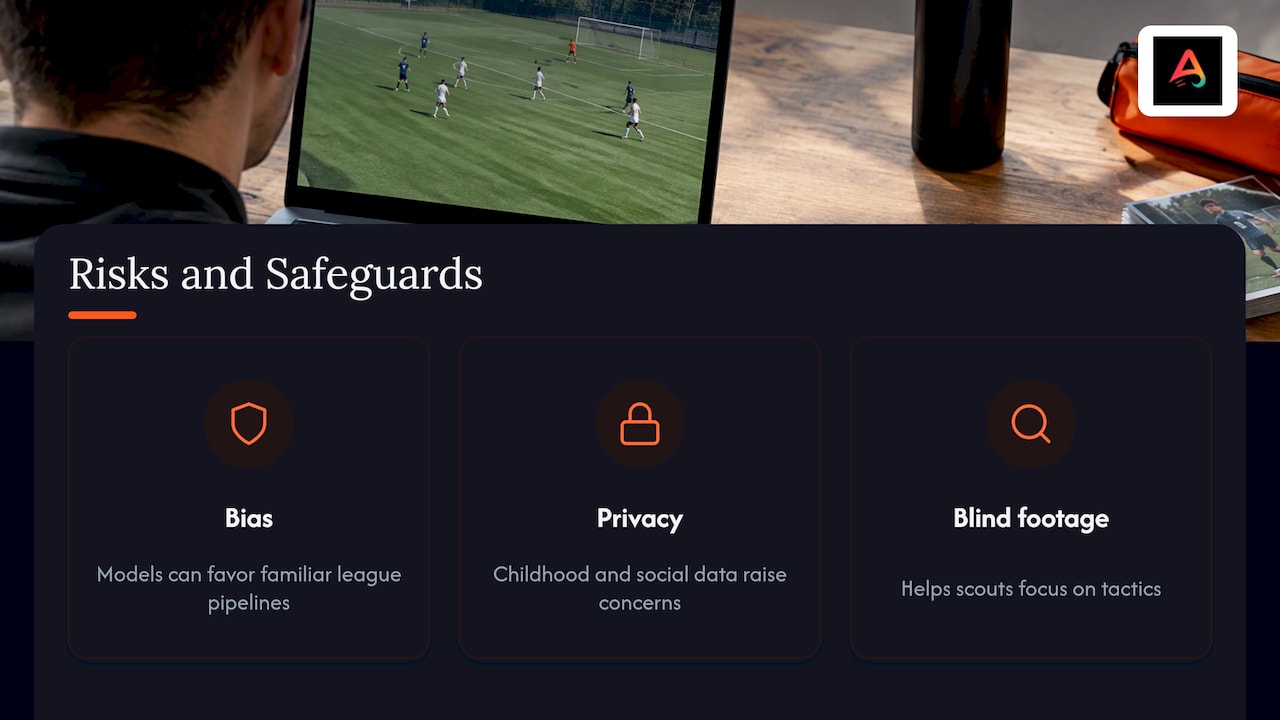
There is a fix in progress. A study with a professional North American soccer team found that AI-anonymized “blind” footage helped scouts focus on tactics instead of physical attributes. Used well, the tech can reduce bias, with people still in the loop.
A quick checklist before a minor uploads footage
- Does a parent or guardian give consent, and can they withdraw it?
- Who can view the clips, and for how long are they stored?
- Is the footage used to train models, or shared with third parties?
- Does the report explain how a score was reached, or is it a black box?
- Is the assessment one input among several, or the whole decision?
A 2026 literature review in youth sport recommends bias auditing, privacy protection, informed consent and explainability before deployment, and says coaches should let algorithmic output inform their judgment, not replace it. We cover the coach side in more detail in how to verify AI scouting reports for youth teams.
How coaches and parents should use an AI report
Treat it like a fitness test result: one reading on one day.
- Use it to screen, then look in person. Researchers recommend a tiered approach: broad early screening by machine, then structured expert evaluation of context, adaptability and maturity.
- Triangulate. The Decision Lab suggests combining at least three independent kinds of evidence: physical metrics, perceptual-cognitive tasks and behavior tracked over time.
- Remember what cameras miss. U.S. Soccer’s COO says AI can’t yet read a player’s tone of voice to a teammate after a mistake, or body language when the team goes up or down. Scouts still own that.
- Re-test. A 14-year-old’s numbers are a snapshot. Compare against the same player three months ago, not against a stranger.
- Track development. Progress over a season is the story. For ideas on structured, personalized app coaching, personalized app coaching covers what to look for in a program that follows growth over time.
For tryouts specifically, see what AI tryout evaluation can and can’t tell a coach.
Getting noticed without waiting for a scout
You do not need a recruiting algorithm to build a profile. Film clean game and drill footage. Keep a simple record of stats and dates. Get a coach to vouch for your work habits. Play often against different opponents, because a model trained on varied data sees you better than one trained on three games.
The unglamorous part matters too: forms, waivers and schedules. Scouts and club staff move on from players whose paperwork is a mess.
Where Athlo fits
Athlo (athloapp.com) is a free app for iOS and Android that puts local sports in one place. For this topic, the relevant pieces are AI Video Analysis for athletes who want to study their own play, Coaching & Training, where you can book and pay a coach in-app, and a parental view that lets a parent manage a kid’s sports life from one account without the child needing a device or account. Teams can keep schedules, chat, medical forms and waivers together through Team Management, and clubs can look at the youth sports tools. Plans are Free, Athlo Plus at $3.99 per month and Athlo Pro at $7.99 per month.

Our perspective
Here is how we see AI scouting. The best thing it does is widen the circle. A kid in a small town, with a phone and a few good clips, should be able to be seen. That is a real win.
But the research is clear that the tool is a screener, not a judge. Models inherit the habits of the data they were trained on, and kids develop on their own schedule. So we build for the whole sports life around the data: finding a game, booking a coach, keeping forms in order, giving parents one place to see it all, and letting athletes review their own video with AI Video Analysis.
Our advice to players: get your film in order, ask who can see it, and keep working with a real coach. Our advice to parents: you stay in charge of consent. Our advice to coaches: let the numbers start the conversation, then finish it yourself.
Abdulazeez
FAQ
Can AI scouting help a high school athlete get recruited?
It can help you get seen, especially if you live far from the big academies. Clean drill footage and consistent stats give a recruiter something comparable to review. It does not replace game film, coach recommendations or in-person looks, and researchers say AI should complement, not replace, traditional evaluation.
Is AI scouting more accurate than human scouts?
In one NBA study, a model predicted future elite players at 87.3% accuracy against 68.5% for traditional scouting. Youth sport is harder: reviews found accuracy varies widely and models often weaken when moved to a different club. The authors of both conclude that people still need to make the call.
Is it safe to upload my child’s video to a scouting app?
Only after you know who sees it, how long it is stored and whether it trains models or goes to third parties. A parent or guardian should give consent. If an app can’t answer those questions plainly, hold off on uploading.
Can AI miss late bloomers?
Yes. Researchers note that models can reinforce biases from physical maturation and relative age, so early developers look better than they are. Re-test over time and have a coach weigh in on growth and attitude.
Sources
- U.S. Soccer is using AI to scout 70 million teenagers (Fortune)
- The Role of Machine Learning in Talent Identification for Youth Team Sports (PMC)
- Psychomotor and visual skills underlying position in elite youth baseball (PLOS ONE)
- Key Anthropometric and Physical Determinants in the NBA Draft Combine (Frontiers in Psychology)
- Communication in Physical Sciences, 2025, NBA draft prediction study
- Artificial intelligence in football talent identification (Frontiers in Sports and Active Living)
- BGU Study Warns AI Sports Scouting May Reinforce Bias (The Media Line)
- Researchers pioneer use of AI to reduce bias in sports scouting (TechXplore)
- Artificial intelligence, algorithmic governance, and social equity in sport (Lentera)
- Debiasing Talent Decisions in High-Performance Sports (The Decision Lab)
Ready to get your sports life in one place? Download Athlo from the App Store or Google Play.
Recommended
- AI Tryout Evaluation: What It Can and Can’t Tell a Coach
- Keep Minors Safe: Verify AI Scouting Reports for Youth Coaches
- AI Sports Video Analysis for Athletes
- Player Comparison Metrics: What to Compare and What to Ignore