Pickup Game Liability: 4 Steps After Injury for Players and Hosts
Most pickup-game injuries never go to court, and when they do, the player usually loses. Courts treat basic contact and rolled ankles as risks you accepted the moment you laced up. Fellow players only get held liable when their conduct crosses into recklessness or intent to harm, while facility owners can be on the hook for hazards they should have fixed. Your best move after any injury: get medical care, document everything, and hold onto that evidence before you decide what comes next.
TL;DR:
- Courts mostly treat pickup-game injuries as inherent risks, unless a player’s conduct crosses into recklessness or intent to harm.
- Liability for injuries caused by reckless or intentional actions depends on evidence such as video, witnesses, and specific conduct beyond normal sport contact.
- Public and private facility owners may be liable if they ignore hazards like damaged courts, inadequate lighting, or broken equipment, especially on private premises.
- Liability waivers are limited; they do not protect against gross negligence or reckless behavior, and most casual games lack insurance coverage, leaving injuries to personal health plans.
- Organizers who charge fees or manage recurring games should implement formal procedures, like digital waivers and attendance tracking, to reduce legal exposure.
Table of Contents
- Pickup Game Liability and the Assumption-of-Risk Doctrine
- Player Vs. Player: Negligence, Recklessness, and Intent
- When the Court or Field Owner Is on the Hook
- What Liability Waivers and Insurance Actually Cover
- What to Do Right After You Get Hurt
- Prevention and Etiquette That Actually Reduce Risk
- Athlo Resources for Organizers Who Host Regularly
- How Liability Laws Differ From State to State
- Do Parks and Recreation Departments Have Any Role Here?
- Can the Person Who Organizes the Game Get Sued Too?
- Keep the Game Fun, Not Litigious
- Manage Your Pickup Games Without the Legal Guesswork
- Sources
- FAQ
Pickup Game Liability and the Assumption-of-Risk Doctrine
Assumption of risk is the reason most pickup-game lawsuits die early. Courts apply “primary” assumption of risk to inherent dangers, like getting boxed out hard under the rim or catching an elbow going for a rebound. You signed up for that risk when you played. “Secondary” assumption of risk covers situations where you knowingly kept playing despite a known hazard, like a slick patch of court, which can also limit what you can recover.
Judges frequently treat pickup games differently than organized league play. In a pickup run, there is no coach, no ref, and no rulebook beyond what the group agrees on, so jurors can rely on common sense instead of expert testimony to decide what a “reasonable player” would do. Court analysis distinguishing pickup games from league play shows this cuts both ways: fewer hoops to sue, but also fewer excuses for players who ignore obvious dangers.
Assumption of risk has real limits, though. It generally will not protect someone who:
- Throws a punch or shoves another player out of anger, not competitive contact
- Plays with reckless disregard for others’ safety, like a hard slide tackle with cleats up
- Fails to warn about a hazard that was not obvious, like broken glass on a field
The assumption-of-risk defense typically evaporates once intent or gross negligence enters the picture.
Player Vs. Player: Negligence, Recklessness, and Intent
Not every hard foul opens the door to a lawsuit. Negligence requires proving someone owed you a duty of care, breached it, and caused your injury as a result. In pickup ball, courts usually hold that ordinary contact, even a hard screen or a collision going for a loose ball, does not count as a breach. You agreed to play a contact sport.
Recklessness and intentional conduct are different animals entirely. A player who deliberately elbows you during a dead ball, or who keeps throwing wild punches after a hard foul, has stepped outside what the game allows. Courts look for conduct that goes well beyond the norms of the sport.
If you’re building a case, evidence matters more than memory. Useful proof includes video from a phone or a bystander who caught the moment and multiple witnesses who saw the same sequence of events.
Without one of those, a “he said, she said” claim rarely survives.
When the Court or Field Owner Is on the Hook
Premises liability shifts the question from “what did another player do” to “what did the property owner fail to fix.” Owners and operators, whether it’s a city park, a private gym, or a school gym rented out after hours, generally owe visitors a duty to maintain reasonably safe conditions and warn of hazards they knew about or should have discovered.
Public entities often get extra protection. Many jurisdictions carve out immunity for “hazardous recreational activities” on public property, shielding cities from lawsuits tied to inherent sports risks even when the facility itself has flaws. Recreational injury immunity laws vary widely by state, so a claim that works against a private gym might fail against a municipal rec center.
Conditions that commonly support an owner-liability claim include:
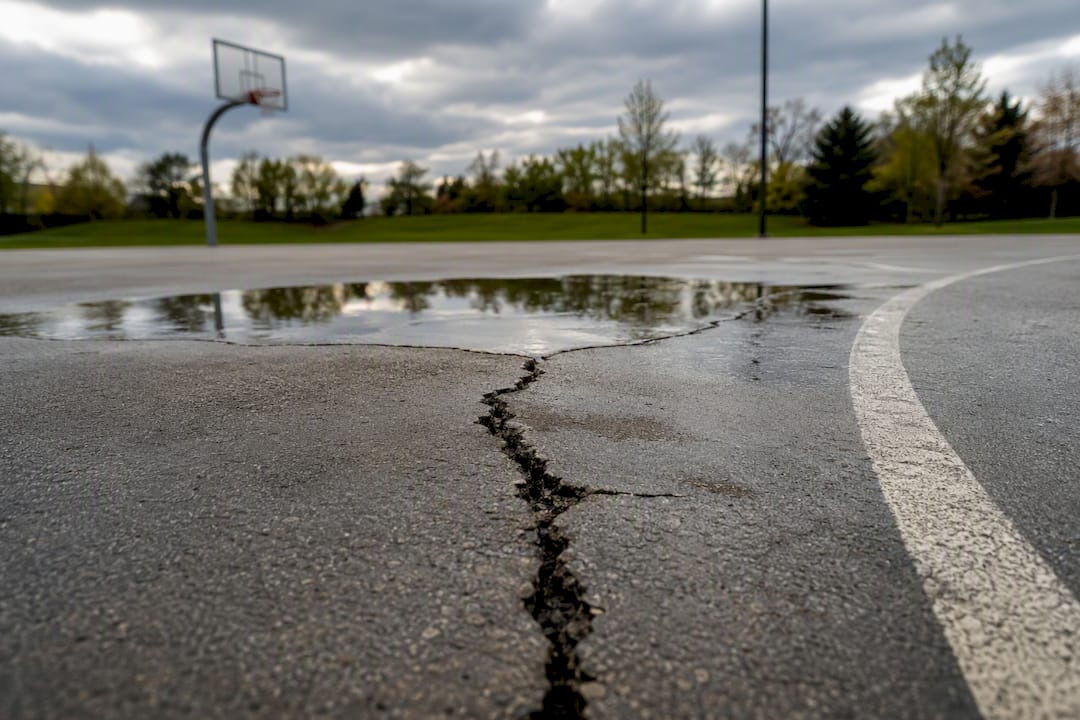
- A cracked or buckled court surface that was reported and never repaired
- A loose or broken rim, backboard, or goal that collapses during play
- Inadequate lighting that hides holes, curbs, or debris on the field
What Liability Waivers and Insurance Actually Cover
A signed waiver tells participants they’re accepting the game’s ordinary risks and won’t sue the organizer for them. That’s the theory. In practice, waivers hit real limits. Minors generally can’t sign away their own legal rights (a parent’s signature carries more weight but still isn’t bulletproof), and most states won’t enforce a waiver against gross negligence or reckless conduct no matter what the paper says. A poorly worded or one-sided waiver can also get thrown out as unconscionable.
Most casual pickup runs carry zero insurance, which is exactly why injuries there tend to fall on individual health coverage. Hosted events are different. Organizers running a paid or ticketed game can look into:
- General liability insurance covering the event itself
- A single-day sports event policy for one-off tournaments or leagues
- Requiring signed waivers plus basic medical-history forms before anyone plays
Pro Tip: If you’re charging even a small fee to play, that shift from “casual pickup” to “hosted event” changes your legal exposure. Treat it accordingly.
What to Do Right After You Get Hurt
- Get medical attention and make sure it’s documented. Medical records become the backbone of any future claim, insurance or legal.
- Photograph the scene immediately: the court surface, the equipment, any visible defect, and your own injury.
- Get names and contact info from witnesses before everyone scatters.
- Report the incident to facility staff, park rangers, or whoever runs the space, and request a copy of any incident report.
Pro Tip: Keep every bill, receipt, and text message related to the injury in one folder on your phone. You will not remember the details in six months, but the paper trail will.
Prevention and Etiquette That Actually Reduce Risk
Basketball alone accounts for a staggering number of injuries every year, and older or out-of-shape players face the sharpest spike in risk when they jump into full-speed runs cold. A five-minute warm-up and matching your intensity to your actual conditioning, not your college-glory-days memory, prevents more injuries than any waiver ever will.
Group norms matter just as much:
- Agree on fouls before the game starts, not after the first hard hit
- Bench or remove any player who escalates to shoving, swinging, or intentional cheap shots
- Walk the court or field for hazards before tip off
For structured play, our pickup basketball etiquette guide covers the small habits, like calling your own fouls honestly, that keep games from turning ugly. Contact sport safety protocols from gym operators offer a useful outside perspective on managing physical play before it boils over.
Pro Tip: The fastest way to shut down a legal headache is to never let the dangerous player back on the court. Removing one bad actor does more than any waiver.
Athlo Resources for Organizers Who Host Regularly
If you’re running the same weekly run or organizing a bigger event, the informality that makes pickup fun is also what makes liability murky. LinkUp helps hosts find players and manage attendance for pickup games, while Athlo’s digital waivers and medical forms let you collect signatures and health info before anyone steps on the court. For paid events, QR check-in keeps a clean record of who actually showed up. Our guide on organizing a pickup soccer game that actually happens and our checklist for hosting a paid pickup game walk through the practical side of running things without killing the vibe.
How Liability Laws Differ From State to State
Pickup game liability doesn’t work the same way everywhere, and that catches a lot of players off guard. Some states apply a strict version of assumption of risk that bars almost any recovery for ordinary sports contact. Others use a comparative negligence system, where a jury can assign a percentage of fault to each party and reduce (rather than eliminate) a damages award.
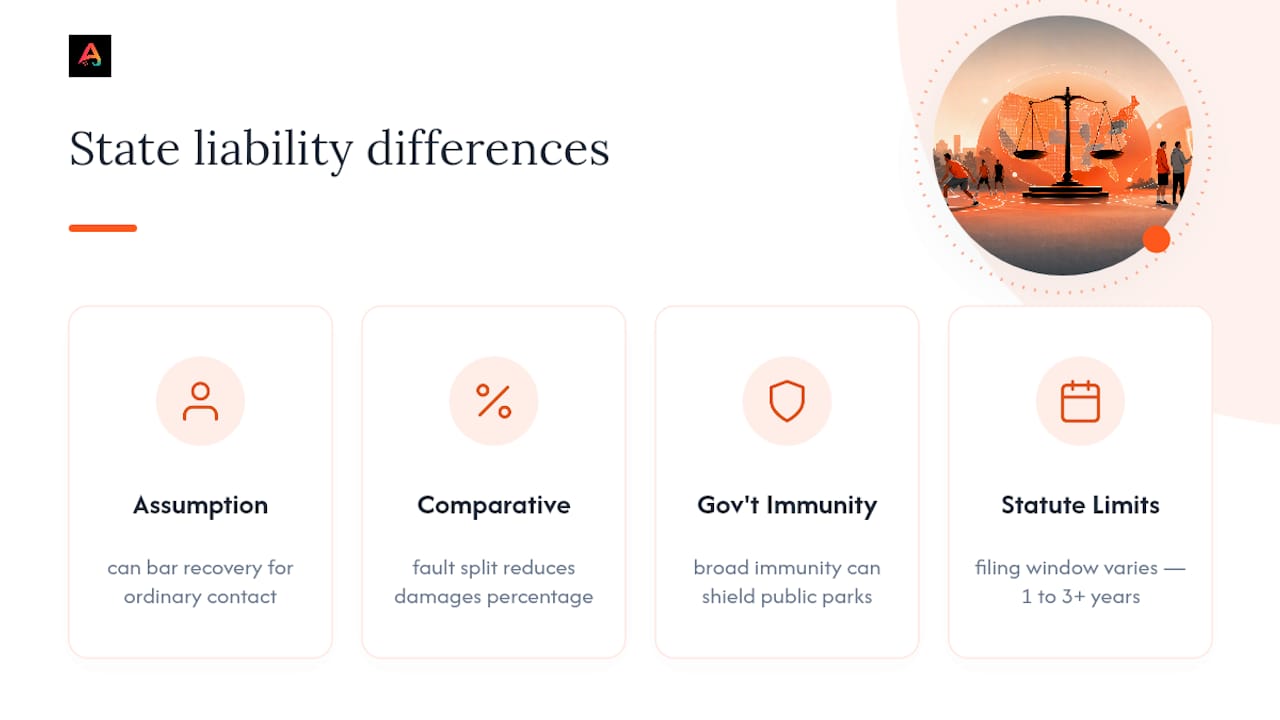
Government immunity statutes add another layer of variation. States with broad “hazardous recreational activity” immunity make it very difficult to sue a city-run park or rec center for an injury tied to inherent game risks, even when the facility had a real defect. Other states carve out narrower immunity, leaving more room for a premises claim against a municipal court or field. A state-specific breakdown covering Indiana shows how much a claim’s outcome depends on where the injury happened, not just what happened.
Statutes of limitations differ too. Some states give you just one year to file a personal injury claim; others give you two, three, or more. Miss that window and it doesn’t matter how strong your evidence is.
If you’re hurt during a pickup game and considering legal action, the venue’s home state matters as much as the facts of the injury itself. A conversation with a local personal injury attorney, even a quick consultation, will tell you far more than a general guide ever can, because they know exactly how your state’s courts have ruled on similar cases.
Do Parks and Recreation Departments Have Any Role Here?
Local parks and recreation departments sit in an odd spot. They don’t organize your pickup game, set the teams, or referee anything, but they own and maintain the courts, fields, and gyms where most informal games happen. That ownership role is where their liability exposure actually lives.
A rec department’s basic responsibilities usually include maintaining safe surfaces, fixing reported hazards within a reasonable time, providing adequate lighting for evening play, and posting warnings about known dangers, like a pool deck that floods after rain or a court with a persistent crack. When a department drops the ball on maintenance, the premises liability framework applies to public property much like it does to private gyms, minus whatever immunity the state grants public entities.
Some cities also set facility rules, like posted hours, capacity limits, or permit requirements for organized use of a public court. Ignoring those rules as an organizer can complicate a liability claim later, since it may suggest the injury happened under conditions the facility never sanctioned. If you’re running a recurring pickup group at a public park, it’s worth a quick call to the parks department to ask about permit requirements and any incident-reporting process they already have in place. That five-minute call can save real headaches if someone ever gets hurt on their watch.
Can the Person Who Organizes the Game Get Sued Too?
Yes, and this is the part most casual organizers never think about until it’s too late. Simply texting “5pm at the park, who’s in” every week doesn’t create much legal exposure. But once you start setting rules, collecting money, renting a court, or acting as the de facto authority figure, courts may start treating you less like a fellow player and more like an event operator.
That distinction shows up most clearly around paid or ticketed pickup runs. An organizer who charges a fee, books a facility, or advertises a recurring session has taken on responsibilities a random participant never had, like vetting the venue, communicating basic safety rules, and possibly buying liability coverage. Sports and recreational injury liability discussions consistently point to quick removal of dangerous players as one of the clearest ways organizers protect themselves, since letting known aggressive behavior slide can look like negligent supervision after the fact.
Group leaders don’t need a law degree to manage this risk. Setting expectations up front, keeping a simple record of who showed up, and acting fast when someone’s play turns dangerous covers most of the practical ground. The organizers who get into legal trouble are almost always the ones who saw a problem player coming and did nothing about it.
Keep the Game Fun, Not Litigious
Pickup ball works because nobody needs a permission slip to play. Protect that by setting simple rules, calling your own fouls, and cutting loose anyone who turns physical into personal. Legal recovery exists for real harm, but it’s slow, uncertain, and expensive. Prevention still beats litigation every time.
— Abdulazeez
Manage Your Pickup Games Without the Legal Guesswork
Athlo gives hosts a middle ground between “text thread and a prayer” and hiring a lawyer for a weekly run. Instead of chasing signatures on paper or hoping everyone remembers the rules you agreed to last month, LinkUp lets you list your game, manage who’s coming, and keep attendance on record.

For anyone charging a fee or running a recurring session, digital waivers and medical forms put a signed record in place before anyone steps on the court, and event ticketing with QR check-in gives you a clean log of exactly who showed up if something ever goes sideways. None of this turns your Tuesday-night run into a corporate event. It just means you’re not relying on memory and good vibes if someone gets hurt. Download Athlo from the App Store or Google Play and set up your next pickup game in a few minutes.
This article is general information, not a substitute for advice from a qualified lawyer. Consult a qualified legal professional about your own circumstances before acting on anything here.
Sources
- We got next! Injured during a pick-up game, no expert needed; injured during a league game, get an expert.
- Assumption of risk: complete guide to understanding this critical legal defense
- Recreational injury immunity laws
- Older players court peril in pickup basketball games
FAQ
What Are the Basic Rules for Playing Pickup Games?
Pickup games run on whatever rules the players on the court agree to before starting, like call-your-own-fouls, win-by-two, or make-it-take-it. There’s no official rulebook or referee, which is exactly why courts treat pickup games differently than organized league play when deciding liability.
Can You Be Sued for Injuring Someone in a Pickup Game?
Yes, but only in limited situations. Ordinary contact injuries are usually protected under assumption of risk, while intentional acts like throwing a punch or reckless conduct like a deliberately dangerous play can lead to a successful negligence or assault claim.
Is a Sports Injury Considered an Accident?
Most sports injuries, like a rolled ankle or a jammed finger from routine contact, are treated as accidents tied to the inherent risk of the game. An injury caused by an intentional or reckless act, like a cheap shot thrown in anger, is generally not treated as a simple accident in the eyes of the law.
Are Professional Athletes Allowed to Play in Pickup Games?
This depends entirely on individual contracts and league rules rather than any universal restriction. Many professional contracts include offseason activity clauses that limit or prohibit unsanctioned games specifically to protect the athlete and team from injury risk outside team supervision.
How Can Athlo Help Me Manage Liability Risk as a Host?
Athlo won’t file paperwork for you, but LinkUp helps you organize and track who’s attending your pickup games, and the digital waivers and medical forms tool lets you collect signed releases before people play. Pricing for Athlo Plus and Athlo Pro, along with the free tier, is listed at Athloapp.