Pickup Basketball Etiquette: Five Moves to Fit In on Your First Run
To fit in at pickup basketball, show up ready, call fouls honestly, and follow the court’s local rules for check ball, scoring, and rotation. That’s the whole game inside the game. Say “next” the right way, keep your calls clean, play defense, and ask one quick question if the run’s custom isn’t obvious. Do that, and you’ll get picked up again next time.
TL;DR:
- Knowing the exact scoring format, such as whether games go to a certain target or are win by two, helps prevent misunderstandings and arguments.
- Calling fouls only when contact clearly affects the shot or dribble maintains respect and prevents disputes from escalating during the game.
- Asking “win by two or straight to 11” before starting a game clarifies rules and ensures everyone plays by the same expectations.
- Respecting the line order and rotation method, and avoiding mid-run insertions, supports fair team selection and smooth gameplay.
- Using a pregame question to clarify rules like “do made shots through contact count” reduces confusion and helps establish shared customs upfront.
Table of Contents
- The Pickup Basketball Etiquette Checklist For Your First Run
- How Pickup Basketball Games Actually Run
- Foul-Calling Norms And How And-1s Get Handled
- Joining A Run And How Teams Usually Get Picked
- What Wins You Respect On The Court (And What Kills It Fast)
- Settling Calls Fast And Keeping The Run Safe
- Format-Specific Etiquette: 21, Half-Court, And Full-Court Runs
- Dos And Don’ts To Memorize Before You Play
- How Athlo Helps You Find Well-Run Pickup Games
- Sportsmanship Doesn’t End When The Buzzer (Sort Of) Sounds
- Taking Care Of The Ball, The Court, And Your Shoes
- Talking On The Court: Calling Screens And Switches
- When To Call Timeouts And Handle Substitutions
- One Habit Worth Adopting
- Find Your Next Run With Athlo LinkUp
- Sources
- FAQ
The Pickup Basketball Etiquette Checklist For Your First Run
You don’t need to memorize a rulebook. You need five moves that signal you know what you’re doing.
- Claim your spot right. Walk up, ask “who’s got next?” and say “I got winners” or “I got next” to whoever’s organizing the line. Don’t sneak into a run without saying anything.
- Check the ball before every possession starts. Stand at the top of the key, bounce or hand the ball to a defender, and wait for it to come back before play begins.
- Move the ball to open teammates. Nobody invites back the guy jacking up threes on every touch.
- Play defense like you mean it. Effort gets noticed faster than scoring.
- Call only what you’re sure of. A borderline foul call in the first five minutes tells everyone how the rest of your day is going to go.
How Pickup Basketball Games Actually Run
Pickup basketball has no referees, no shot clock, and no rulebook taped to the wall. It runs on custom, and the custom is agreed on before the ball goes up. That’s the core of pickup basketball etiquette: players police themselves, which only works when everyone plays by the same understood terms.
Here’s what those terms usually look like:
- Check ball starts every possession. After a made basket, a defensive rebound, or a stoppage, the ball gets checked back to a defender before the offense can attack. Skipping this is one of the fastest ways to get called out on your first game.
- Scoring runs on ones and twos, or twos and threes. Games to a target score are standard, and most runs require winning by two baskets rather than hitting the target exactly on a single shot. Basketball for Coaches notes these formats show up almost everywhere, though the target number shifts by court and region.
- Make-it-take-it keeps the winning team on offense. Score, and you keep the ball. Miss, and possession flips. Some courts run losers-out instead, where the losing team walks off and a new team step on.
- Ties get settled fast, not argued. Shoot for it, use a possession arrow if the court has one, or default to “defense earns the ball back.” Nobody wants a five-minute debate over a jump ball in a game with no referee.
The smartest move before you even shoot a warmup jumper is asking one question out loud: “We’re playing win by two, or straight to 11?” That single sentence, backed by pregame agreement guidance from pickup etiquette guides, prevents most of the arguments that end runs early. Courts vary enough that assuming your home gym’s rules apply everywhere is how newcomers get a reputation before they’ve even scored.
Foul-Calling Norms And How And-1s Get Handled
Self-officiation only works if fouls get called by the player who got hit, and only for contact that’s actually obvious. Pickup basketball etiquette leans hard on restraint here: reputable guides on pickup fouls recommend calling contact only when it clearly affected the shot or the dribble, not every graze on a drive.
And-1 situations split by court. On some runs, a made shot through contact counts and the free possession is skipped entirely. On others, the bucket counts and the shooter still gets to check the ball back in. Ask before the game starts:
- “Do made shots through contact count?”
- “Is there a free throw line, or does the shooter just check it back in?”
Pro Tip: Keep your foul calls quiet and consistent all game, not just when you’re losing. Nothing burns your invite back faster than a defender who calls contact only in the fourth quarter of a close game.
If contact happens, the script is short: say “foul,” name what happened, and check the ball back up top. No speeches.
Joining A Run And How Teams Usually Get Picked
Every court has a line, even when nobody’s written it down. Learning how to join a pickup basketball game respectfully starts with reading that line correctly.
- Ask who’s next before you assume you’re in. “I got next” only works if you say it to the right person and there isn’t already someone ahead of you.
- Respect first-come-first-served order. If three guys were waiting before you walked up, you’re behind them, not ahead.
- Watch for the selection method. Some gyms use captains who pick players one at a time. Others go strictly by whoever’s been waiting longest, and a few use a whiteboard sign-up sheet near the door.
- Know the rotation timing. Winners-stay runs usually cap around two or three straight wins before newcomers rotate in, especially when a line is forming.
Latecomers get folded into the next available team, never inserted mid-run. If you show up and the line’s long, that’s your cue to ask when the next full rotation happens rather than hovering at half court.
What Wins You Respect On The Court (And What Kills It Fast)
Reputation at pickup runs forms faster than most players expect. Basketball for Coaches points out that consistent effort and honest calls build the kind of trust that gets you picked up again within a single session, not over weeks.
What earns you a return invite:
- Playing real defense, not just standing near your assignment.
- Passing to the open man instead of forcing your own shot every possession.
- Hustling for loose balls and boxing out even when the score doesn’t demand it.
- Rotating fairly when new players show up to join.
What gets you quietly avoided next time:
- Ball-hogging or ignoring open teammates.
- Calling soft fouls to slow down a run you’re losing.
- Nonstop trash talk that isn’t backed by actual play.
- Cherry-picking on defense to sneak easy buckets on offense.
Settling Calls Fast And Keeping The Run Safe
Arguments kill pickup games faster than bad shooting nights. The fix is almost always faster than the fight: replay the possession, shoot for it, reset with a check ball, or let whoever’s next in line make the call if the two sides can’t agree.
Most disputes are genuinely small, a foot on the line or a hand that maybe grazed a shooter, and treating them that way keeps the run moving. Save real escalation for real problems.
- Involve staff for fights, threats, or repeated dangerous contact. Facilities like the YMCA explicitly reserve the right to remove players over excessive physical contact or fighting, and gym staff would rather step in early than watch it boil over.
- Never play through a visible injury. If someone takes a hard fall or shows signs of a head injury, stop the run and check on them before anything else.
- Call out dangerous plays immediately. Under-the-basket collisions and hard fouls on fast breaks need a pause, not a shrug.
Format-Specific Etiquette: 21, Half-Court, And Full-Court Runs
The unwritten rules shift depending on what you’re actually playing. Treating every format the same is a common beginner basketball etiquette mistake.
- Game of 21. Every player is for themselves, fouls usually send the fouled player to the free-throw line, and rebounding your own miss is often part of the strategy. Possession rules here are looser since there are no fixed teams to argue on behalf of.
- Half-court 3-on-3. After a defensive rebound or steal, the ball has to be checked or “cleared” back past the three-point line or top of the key before the offense can attack again. Skipping the clear is one of the most common rookie mistakes on half-court runs.
- Full-court 4-on-4 or 5-on-5. Transition speed matters more, cherry-picking (camping near your own basket instead of playing both ends) draws quiet resentment fast, and these games tend to carry more structure, sometimes even informal captains managing substitutions.
Knowing which format you’re stepping into before the ball goes up saves you from calling a foul that doesn’t apply or clearing a ball nobody expected you to clear.
Dos And Don’ts To Memorize Before You Play
| Do | Don’t |
|---|---|
| Check the ball before every possession | Call soft fouls to slow the other team down |
| Pass to open teammates | Hog the ball every possession |
| Play defense on both ends | Cherry-pick for easy buckets |
| Keep your calls consistent all game | Skip the line to sneak into a run |
| Say thanks and shake hands after | Trash talk without backing it up |
Pin these five pairs in your head before your next run. They cover more real-world pickup basketball etiquette than any full rulebook could.
How Athlo Helps You Find Well-Run Pickup Games
Finding a good run shouldn’t take more effort than playing in one. A mobile app’s pickup game discovery feature can help players find and host pickup games nearby, often including QR ticketing and in-app payments for organized runs that charge a small fee to play.
- Browse nearby pickup games instead of guessing who’s playing where.
- Host your own run and use QR check-in so you know who actually showed up.
- Set expectations up front using resources like how to host a paid pickup game or team chat etiquette templates for communicating rules before tip-off.
If you’re organizing regularly, pairing a clear pregame agreement with a tool that handles sign-ups keeps arguments off the court entirely.
Sportsmanship Doesn’t End When The Buzzer (Sort Of) Sounds
Pickup games don’t have a real buzzer, but they have a real end, and how you handle it says as much about you as how you played.
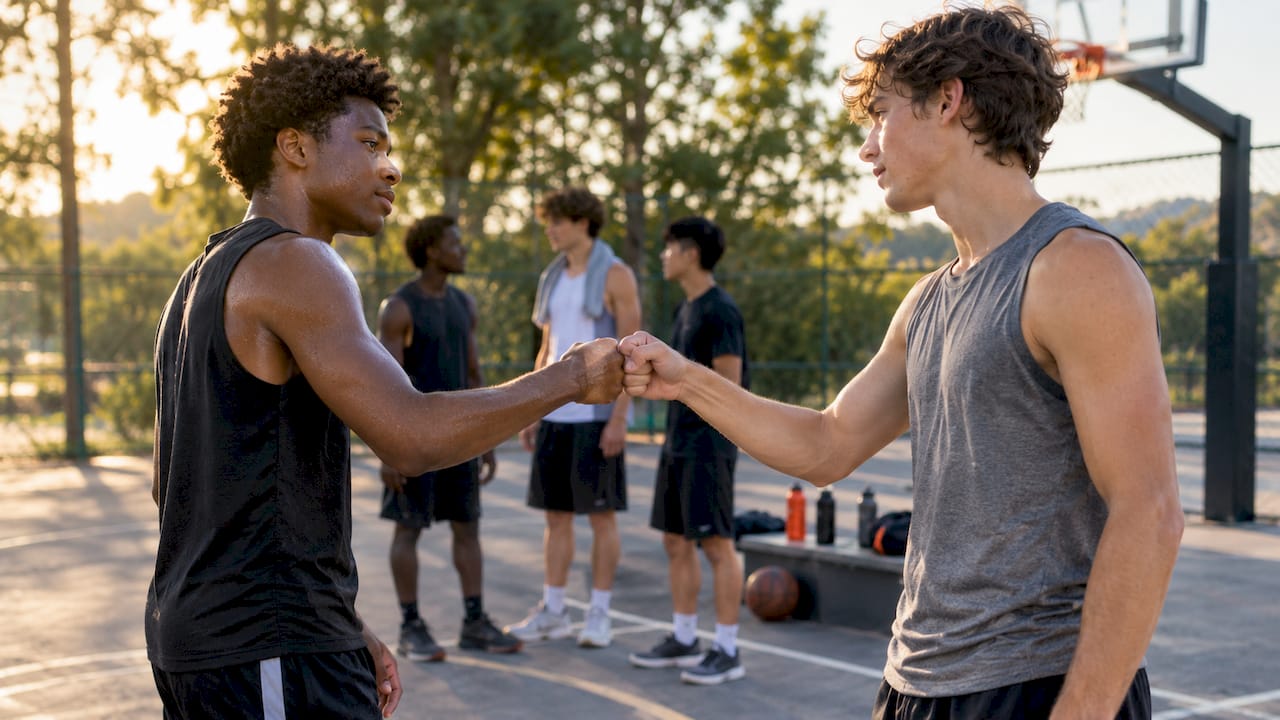
Shake hands or tap fists with the guys you just played against and against, win or lose. It sounds small, but skipping it is noticed more than you’d think, especially after a physical or contested run. If you called a foul someone disagreed with, this is the moment to let it go rather than relitigate it walking off the court.
Complimenting a good play from an opponent, even briefly, costs nothing and builds the kind of goodwill that gets you remembered as someone worth inviting back. The flip side matters too: don’t gloat over a blowout win, and don’t sulk visibly after a loss. Both read as someone who’s not actually there for the game.
If you’re waiting for the next run, make room. Rotating off graciously when your team loses, rather than lingering near the court arguing for a rematch, is one of the clearest signals of pickup basketball etiquette done right. The next group waiting sees exactly how you handle losing, and that impression sticks longer than the score does.
Taking Care Of The Ball, The Court, And Your Shoes
Equipment care sounds minor until you’re the guy everyone’s annoyed at. A few habits separate respectful players from careless ones.
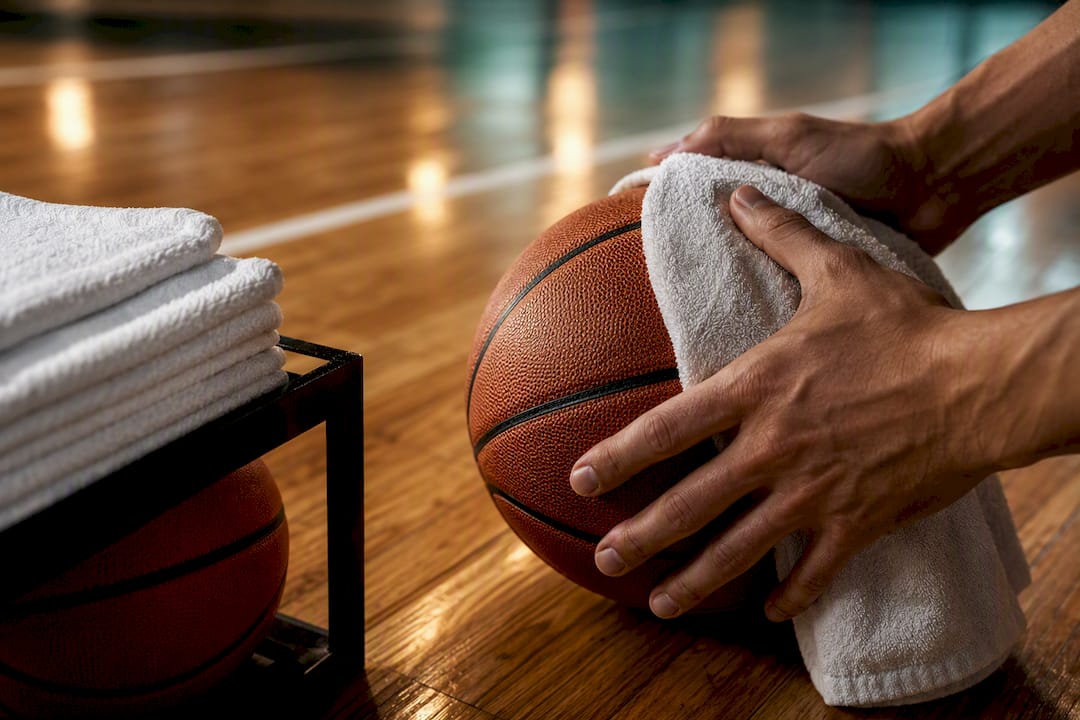
Wipe down the ball if it’s picked up dirt or moisture, especially on outdoor courts after rain or morning dew. A slick ball changes the game for everyone, not just you. If the gym or court provides a rag or towel station, use it between runs rather than assuming someone else will.
Check your shoes before stepping on indoor hardwood. Outdoor tread tracks in dirt and grit that scuffs the floor and creates slip hazards for everyone else running full speed. Most gyms that enforce this seriously will turn you away at the door, so it’s worth checking before you even walk in.
Treat the rim and backboard the same way you’d want a stranger to treat your own gear: no hanging on the rim after dunks unless the court explicitly allows it, and no leaning on backboard supports between plays. Pack up your own water bottles and bags courtside instead of leaving them scattered near the baseline where someone’s going to trip running back on defense.
None of this takes extra time. It just takes noticing that the court and the ball are shared property for the length of the run, even if nobody says so out loud.
Talking On The Court: Calling Screens And Switches
Communication is the difference between a defense that actually functions and five guys guessing. Calling out a screen the instant you see it, “screen left” or “pick right,” gives your teammate a half second to adjust instead of running into a pick blind.
Switches need the same treatment. If you’re guarding someone and a screen forces a swap, say “switch” loud enough for both your teammate and the guy you’re picking up to hear it. Silent switches are how open shooters end up wide open on the perimeter, and it’s almost always because nobody said anything, not because anyone played bad defense.
On offense, calling your own screens helps too. “Setting a pick” lets your teammate know to read it rather than dribble past it accidentally. Even simple calls like “ball” when you’re cutting to the rim, or “shooter” when someone’s spotting up, keep five players moving like they’ve actually run plays together before, even when they haven’t.
This is one of the fastest ways to look like you know what you’re doing on a court full of strangers. Good pickup players aren’t necessarily the most talented ones on the floor. They’re often just the loudest in the right moments.
When To Call Timeouts And Handle Substitutions
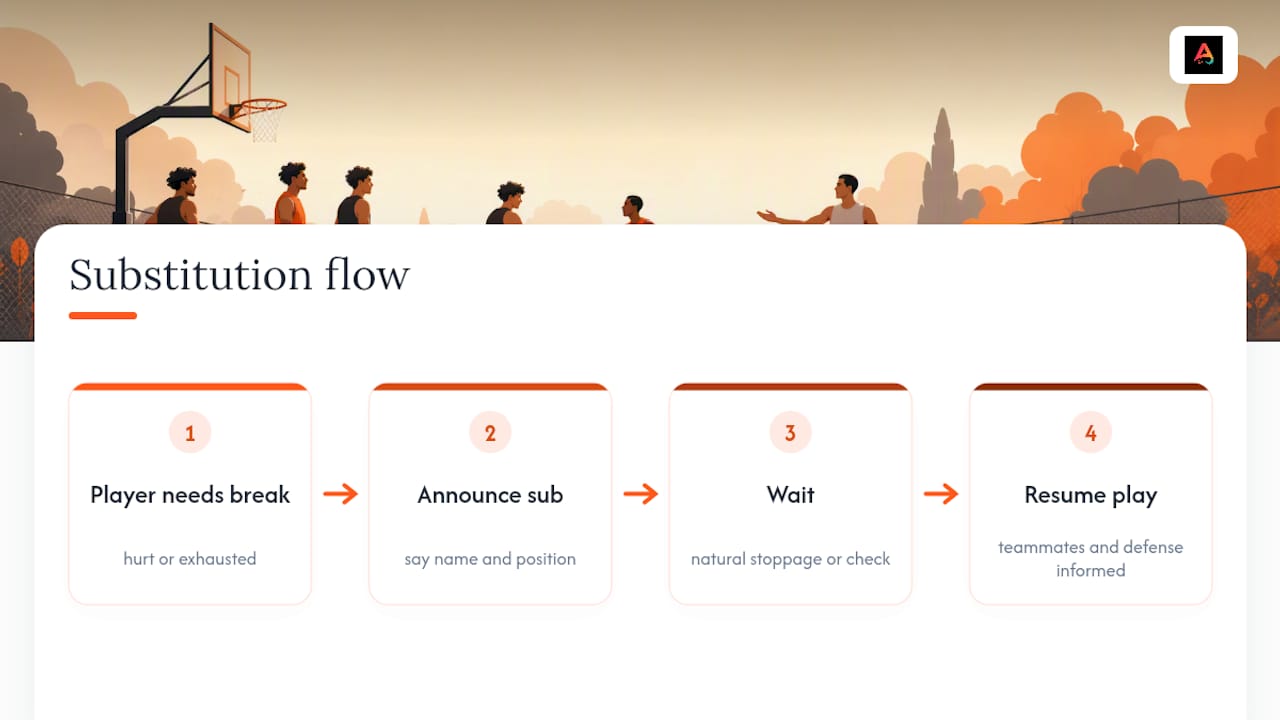
Pickup basketball rarely has official timeouts, but that doesn’t mean you can’t pause play. If someone’s genuinely hurt, tired to the point of risking injury, or the game needs a quick rule clarification, calling a short break is normal and expected.
The key is timing it so it doesn’t feel like you’re stalling. Calling for a breather right after your team gives up a fast-break bucket reads differently than calling one during a natural stoppage, like after a made basket or before a check ball. If you need water or a minute to tie your shoe, say so directly rather than just walking off, which leaves your teammates confused about whether you’re subbing out or coming right back.
Substitutions work best with a heads-up, not a surprise. If you’re swapping in a player waiting on the sideline, say their name and position clearly before the check ball, “he’s got my spot at the four,” so the defense and your own teammates aren’t caught off guard mid-possession. Waiting until a stoppage to make the swap, rather than mid-possession, keeps the run from turning chaotic.
None of this needs to be formal. A few clear words at the right moment is all pickup basketball etiquette asks for here, and it’s usually enough to keep ten strangers playing like an actual team for the next twenty minutes.
One Habit Worth Adopting
The single habit that’s saved more pickup runs than anything else: ask the pregame question out loud, every single time, even at courts you’ve played a hundred times. Rules drift. A regular might be playing with new people who assume different customs, and thirty seconds of “win by two or straight to 11, and do and-1s count” beats five minutes of arguing at 9 to 9 in the second game of the night.
The second habit, smaller but just as useful, is volunteering to keep score or watch the line when you’re not in the current game. It costs you nothing, it makes you visibly useful, and it’s a fast way to get remembered as someone worth inviting back.
Pro Tip: If you’re new to a run, ask your one pregame question to whoever looks like they’ve been there longest, not the loudest voice on the court. Regulars usually know the actual custom; loud voices just think they do.
— Abdulazeez
Find Your Next Run With Athlo LinkUp
Pickup basketball etiquette gets a lot easier when you’re not guessing who’s showing up or whether the run is even still happening. Athlo’s LinkUp feature lets you browse and join pickup games near you, or host your own with QR check-in so nobody’s arguing about who paid and who didn’t.

If you organize runs regularly, setting up a listing means players know the format, the scoring rules, and the cost before they show up, which cuts down on exactly the kind of confusion this whole guide has been about. Check out LinkUp on Athlo to see what’s running near you this week, or download Athlo on the App Store or Google Play to start browsing local games tonight.
Sources
- Pick-up basketball — Wikipedia
- How to Play Pickup Basketball (Unwritten Rules Explained) — Basketball for Coaches
- Pickup Basketball Rules: Fouls, Check Ball & Etiquette — Barry Bekkedam
- Basketball etiquette — YMCA of South Hampton Roads
FAQ
What are the basic rules of pickup basketball?
Games run on check ball to start possessions, self-called fouls, and a pregame agreement on scoring format, target score, and whether made shots through contact count. There’s no referee, so the rules only work if everyone agrees to them before playing.
Why is 69 not allowed in basketball?
This isn’t an actual rule in organized or pickup basketball. Some courts may joke about skipping certain score totals informally for comedic reasons, but no official or widely followed pickup custom bans a specific number.
How do you get good at pickup basketball fast?
Play consistent defense, pass to open teammates instead of forcing shots, and keep your foul calls honest every single game. Reputation for fair, hustling play gets you picked up again faster than pure scoring ability does.
Can you take two steps after picking up the ball in basketball?
Yes, this is the standard two-step rule used in organized basketball, and pickup games generally follow it the same way: you get two steps after your last dribble before you must pass or shoot. Traveling calls are usually rare in pickup unless the violation is obvious.
What should you ask before joining a pickup game?
Ask who’s next in line, what scoring format they’re using, and whether made shots through contact count as an and-1. That single question, recommended by pickup etiquette guides, heads off most disputes before they start.